Download
Abstract
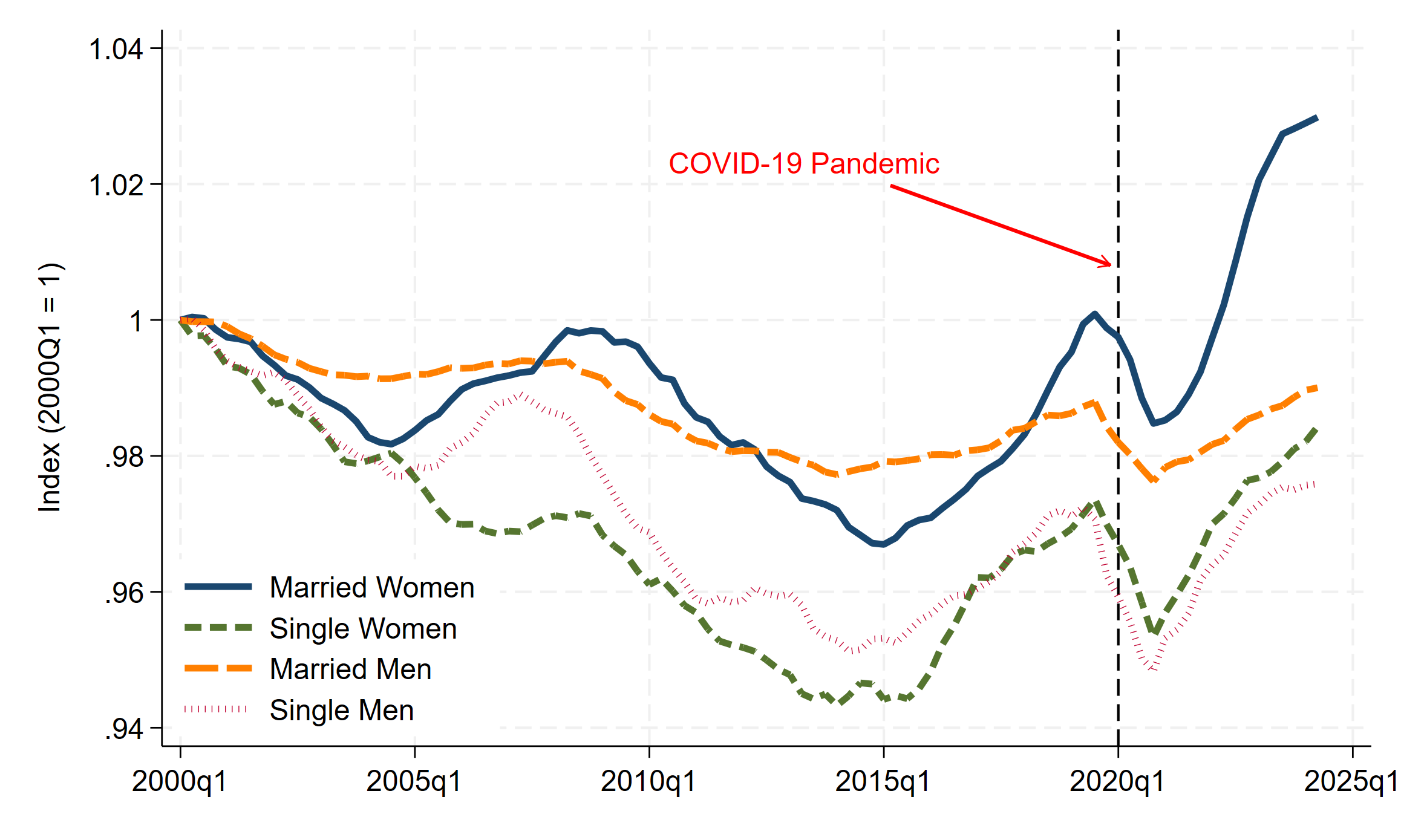
Married women’s labor force participation in the U.S. reached historic highs after the COVID-19 pandemic, despite declining real wages. I hypothesize that expansion of teleworking played a key role in this shift. I provide a set of novel facts to support this view. First, the participation boom of married women is driven by entry into teleworkable jobs. Second, married men in teleworkable jobs sharply increased home-production time, while women’s home-work remained unchanged and disproportionately high. Third, married women experienced a pronounced compression of the wage distribution, largely driven by decreases in pay for teleworkable jobs and at the top, with no comparable decline for men. Together, these patterns suggest a “flexibility trap”: teleworking relaxes time constraints and raises female labor supply, but also intensifies downward wage pressure when willingness-to-pay for flexibility is higher among women. I then develop and calibrate a joint-search model of household labor supply with job amenities. A realistic rise in teleworking availability accounts for the surge in married women’s labor supply and generates higher equilibrium unemployment in the new steady state. The results highlight teleworking as a central driver of post-pandemic female participation and a potential source of gender inequality.
Figure 2: Labor Force Participation by Different Groups